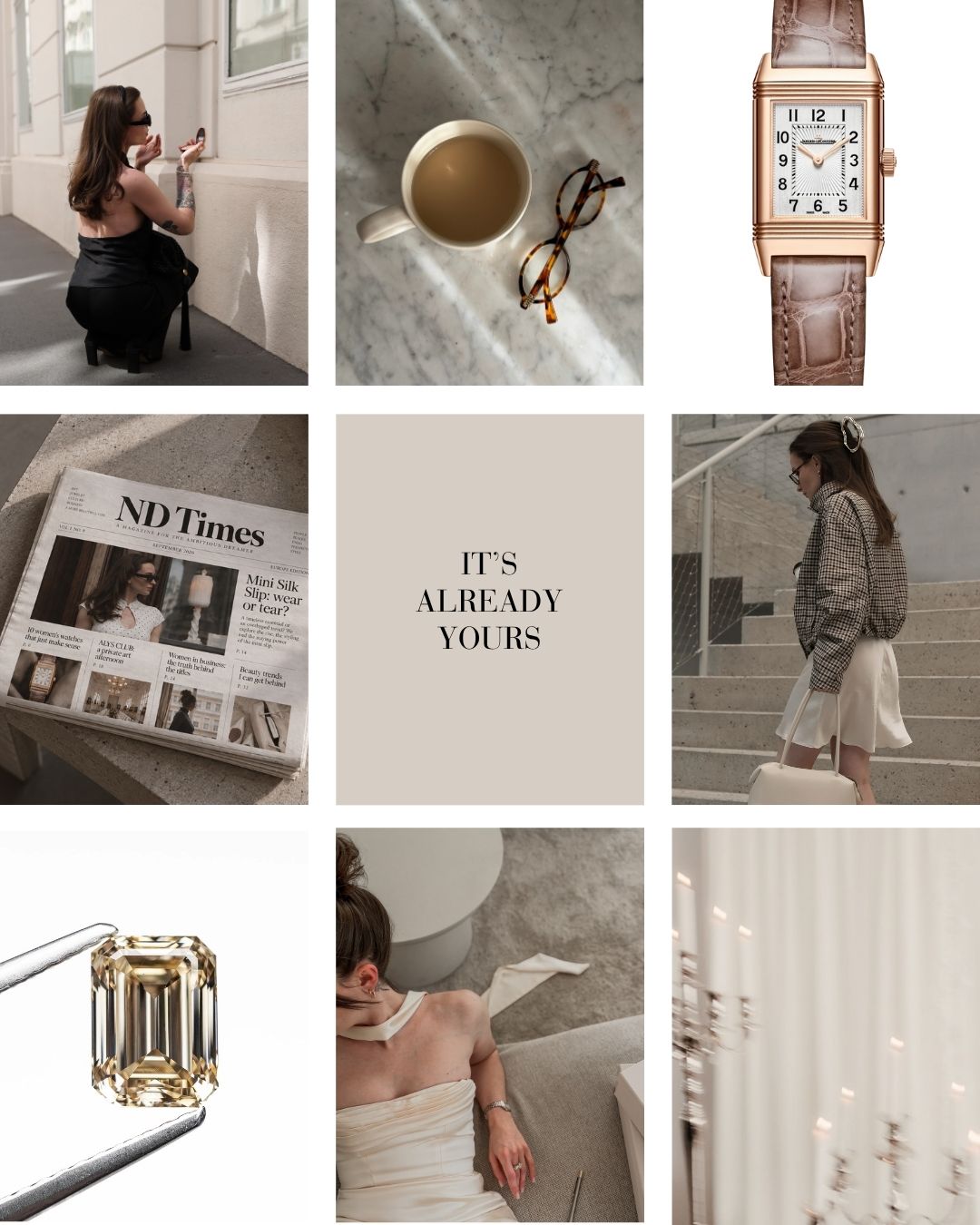
The whole point of vision boards is attention training. The vision boards that involve pasting a hundred photographs of champagne, designer handbags, nice hotels and beautiful dresses onto a piece of paper and then waiting for the universe to understand the assignment are missing the point. There is something much more interesting happening when you use a vision board properly. It can become a visual representation of the life you are trying to build, sure, but more importantly it becomes a way of training your attention, and that is where the psychology becomes much more interesting than manifestation culture would have you believe.
October is particularly good for this. There is something about the beginning of autumn that naturally encourages a reset. You have enough information about the year to know what is actually working, what isn’t, and what you’ve quietly (or loudly?) outgrown. It is a good month to stop asking what you should want and start asking what you actually want the next few months of your life to feel like.
So before opening Pinterest, I would start somewhere much less curated: with your actual life. Look at the last few months and ask yourself what you want more of, what you want to become better at, what you want to experience, and what you’re tired of repeating. The point isn’t to create a fantasy version of yourself who wakes up at 5 a.m., wears cashmere and silk every day, reads three books a week and somehow has a six-figure business by yesterday. The point is to identify the direction: maybe you want your home to feel warmer. Maybe you want to dress more deliberately or travel somewhere new, become more disciplined with your business, or have more dinners with your husband, more books, better sleep, time outside, a healthier body, a different relationship with money – you get what I’m saying.
Those things belong on the board because they represent a life you actually want to inhabit. Then comes the fun part (at least for me): collecting images. But this is where I would impose a little discipline. Do not save something merely because it’s beautiful, but because it makes you feel something specific. A photograph of a beautiful workspace might represent focus. A hotel room might represent travel, but it might also represent solitude, elegance, freedom or simply the feeling of having nowhere to rush to and money that allows that slow pace. A woman wearing a particular outfit might not mean that you want that outfit at all. Perhaps you want the confidence, simplicity or level of personal style that the photograph represents.
Your mood board should therefore contain more than objects. Include environments, colors, textures, people, places, books, meals, art, architecture, clothing, jewelry, movement, work, relationships, rituals and little details of ordinary life. To figure out which things actually belong on your vision board you have to figure out what your values are. Usually, our core values are found in the question “What is my biggest fear?”; if the answer is getting sick then one of your core values is surely health. If you’re afraid of being poor (financially or otherwise) then your value is freedom. If you’re scared of losing someone you love your value is closeness (family, partnership, friends). You get the concept, not get to work! Make a list of 30-50 values and slowly cross out those you can live without, until you get a list of your top 10. Those 10 belong on your vision board, because 10 bring focus, while 50 create chaos and poor boundaries.
I am not a big fan of the idea that you can simply think about something hard enough and cause the universe to deliver it to your front door. But I am very interested in the much less mystical fact that our beliefs influence our behavior, and our behavior influences our circumstances (think quantum mechanics). If you believe you are incapable of doing something, you are less likely to attempt it, less likely to tolerate the discomfort required to learn it, and more likely to interpret early failure or obstacles as evidence that you were right. If you believe something is possible for you, you may approach the same situation differently. You notice opportunities. You ask different questions and speak to different people. You persist for longer, make decisions that are consistent with the person you believe yourself to be, and more importantly with the person you want to become.
The reason vision boards can be so powerful is the fact that they repeatedly put a particular future in front of you that you familiarize yourself with. But familiarity alone is not enough, and this is where manifestation culture often gets the process backwards. Research on goal pursuit suggests that simply indulging in positive fantasies about the future does not necessarily produce action. In some studies, imagining the process of achieving something was more useful than simply imagining the wonderful feeling of having already achieved it. Mental contrasting (imagining the desired future while also confronting the obstacles standing between you and it)combined with specific “if–then” plans has been shown to support goal attainment. A 2021 meta-analysis covering 21 studies and more than 15,000 participants found a small-to-moderate overall effect for this approach. In other words, your October vision board should contain both the vision and the bridge.
If there is a photograph of a beautiful, calm morning on your board because you want your life to feel less rushed, ask yourself what would actually produce that morning. Perhaps it means going to bed earlier, stopping work at a certain hour, preparing breakfast the night before or not answering emails the moment you wake up. If the board contains a photograph of a thriving business, ask what the business version of that photograph looks like on a regular Tuesday afternoon; it might mean making sales calls, improving your offer, adjusting your prices, following up with clients, learning something you currently do not know or finally delegating the thing you keep insisting you have to do yourself. That is the difference between a vision board and a fantasy board.
But very importantly, here are some things I would leave off: anything that makes you feel inadequate, anything that represents someone else’s definition of success, anything you saved purely because it is currently fashionable, and anything so wildly disconnected from your current reality that it becomes entertainment rather than direction. You do not need a photograph of a private jet because you think successful people are supposed to want private jets. You do not need somebody else’s body, relationship, house or career. And you certainly do not need twenty photographs of things you intend to buy. A good vision board should make you think, Yes. That feels like me. Not, I wish I were her.
Once the board is finished, I would actually make a second layer underneath it. For every major image or theme, write down one action that would move you towards it. If the board says travel, research the destination and put dates into your calendar. If it says stronger body, decide when you are exercising and what that realistically looks like. If it says more successful business, identify one thing you have been avoiding. If it says more romance, plan the dinner instead of waiting for romance to spontaneously appear. If it says more money, look at the numbers rather than simply photographing abundance. If it says more creativity, protect an hour for it.
And then make the actions even more specific: Instead of writing “I will work on my business more,” write, “If it is Monday at 9 a.m., I will spend the first hour on sales before opening Instagram.” These kinds of “if–then” plans are called implementation intentions, and they work by connecting a particular situation with a predetermined action, reducing the amount of decision-making required in the moment. This is how you begin making the board functional.
Now, to what I consider the most important part: keep it somewhere you will actually see it. This is why digital vision boards don’t work for me, I need them analog. I need to look at it regularly, but do not turn it into another productivity ritual that requires you to stare at it for fifteen minutes every morning while whispering affirmations. Let it become familiar. More importantly, use it when making decisions. When an opportunity comes up, ask whether it belongs to the life represented on the board. When you are tempted to spend your time doing something that repeatedly leaves you exhausted, ask whether it belongs there. When you are unsure what to prioritize, ask which choice moves you closer to the person and life you have described. This way, your board becomes a filter.
And perhaps that is the most interesting version of manifestation: not sitting still and waiting for your desired life to find you, but becoming so clear about what you want that you start making decisions consistent with it. Our attention is selective. We cannot consciously process everything around us, so our brain is constantly filtering information. Once something becomes important to us, we start noticing it more. We see the business opportunity we previously overlooked. We notice the designer whose work aligns with our taste, we hear the conversation that leads somewhere and recognize the kind of person we want to become because we have spent enough time thinking about what that person actually does. And because we changed what we notice, expect, tolerate and do, our circumstances can eventually change with us.
So make your October vision board beautiful. Of course you should. But underneath all of it, put something much more effective: a plan of action. Because the most powerful vision board is not the one that makes you feel as though you already have everything, but the one that makes you understand exactly what you are going to do next.
Dodaj odgovor