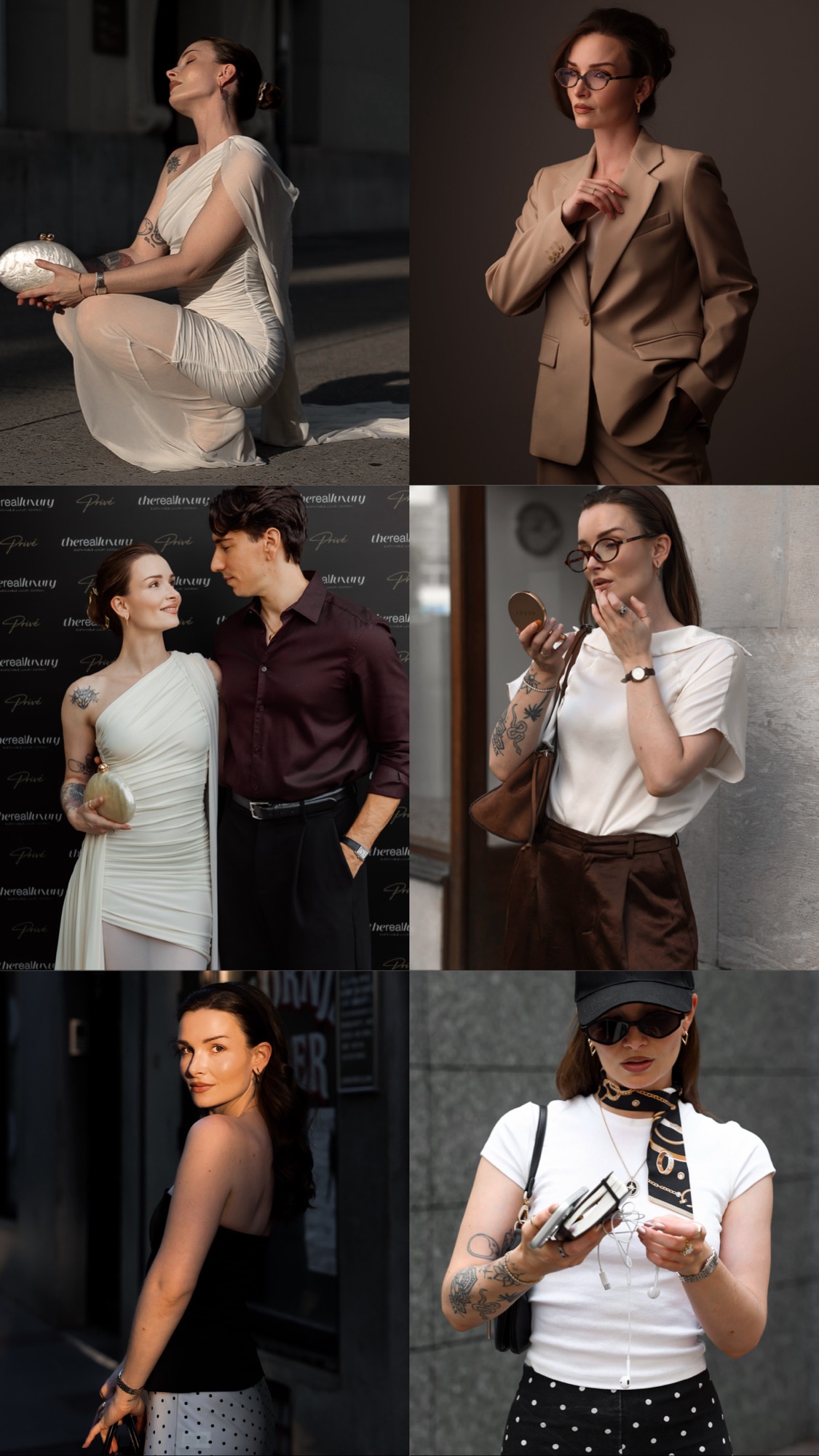
There is a particular kind of ugliness that has nothing to do with your face. I’ve become increasingly convinced that the people you spend your time with can change how you look. Not in the superficial sense that your friends influence your clothes or your haircut, although they certainly can and do. I mean something much more subtle. The wrong environment can slowly disconnect you from yourself, and when you are disconnected from yourself, you lose some of the qualities that make you attractive in the first place. You become quieter when you would normally be expressive. You stop wearing the things you actually like, or talking about the things you are excited about because nobody around you is interested in your views, dreams and ideas. You make yourself less ambitious, less opinionated, less particular, less enthusiastic. You start editing your personality in real time, and eventually, when you look in the mirror, you may not recognize that version of yourself at all. I know this because I have lived it.
A few years ago, I found myself in a friendship circle that, objectively, was perfectly fine. These were not bad people, and there was a sense of normality to it, which for a long while I mistook belonging. Looking back, I think that was the problem: I had reached a point in my life where I thought I had finally found my people, when in reality I had found a space in which I was constantly making myself smaller. The interesting thing is that I did not consciously decide to become less myself. It happened through hundreds of tiny adjustments.
I would suppress an idea because I assumed nobody else would be interested, or they would feel intimidated by it. I would lower my enthusiasm for something because I did not want to appear overly ambitious or particular. I would adapt my taste, make myself more casual, more indifferent. I was trying to find the version of myself that would fit comfortably into the group rather than asking whether the group actually fit the person I was becoming. And this is where I think friendship can become particularly interesting: we talk constantly about finding people who accept us exactly as we are, but there is another question that is arguably more important: Who do you become around these people? Because you can be accepted and still be shrinking.
You can be loved and still be living below your own potential, you can have perfectly pleasant friendships and still find yourself becoming a version of yourself that does not fulfill you. Nothing has to be toxic for something to be wrong for you. Sometimes the problem is simply that the chemistry of the group pulls you in a direction that is incompatible with your own.
For me, one of the clearest signs was how little initiative came back in the other direction. I was often the person coming up with the plans, the ideas, the gatherings, the opportunities, the things we could do together. I was creating movement and generating possibilities, and eventually I realized how strange it was that I was constantly trying to make the friendship more alive. That realization forced me to ask a slightly uncomfortable question: was I surrounded by people who genuinely energized me, or was I constantly supplying the energy myself? At this point it’s only normal you start wondering why you are always initiating, why you are always adapting, why you are always bringing something to the table while simultaneously feeling that you need to make yourself smaller in order to stay seated at it. And perhaps the strangest part was that I thought I was becoming more socially secure when I was actually becoming less authentic. I had confused fitting in with belonging, which took me by surprise. Given all my knowledge, level of expertise and experience I frankly thought that this could never happen to me, so I let down my guard. Mistake. Thankfully one I rectified swiftly.
Belonging does not require you to abandon your preferences, ambitions, aesthetics, opinions or energy. In the right environment, you do not have to constantly calculate how much of yourself is acceptable. And this is where the connection to beauty becomes interesting; we spend an enormous amount of time trying to become more attractive through external means. Better clothes. Better hair. Better skin. Better makeup. (Isn’t this the Revolution skincare tagline?) But some of the most attractive qualities are not things you can purchase or apply. Confidence, presence, curiosity, energy, humour, conviction. The ability to be completely comfortable with your own preferences. Authenticity has a visual quality. You can see when someone feels at home in themselves (you can also see when they don’t). There’s a certain dullness that appears when someone is constantly monitoring themselves. When you are wondering whether you are too loud, too ambitious, too opinionated, too this, too that, part of your attention is no longer available to simply be present. You are watching yourself instead of inhabiting yourself. And I think that changes the way you carry your body, the way you speak, your sense of style, and ultimately the way you are perceived.
The irony that trying to be more acceptable can make you less attractive is not lost on me. There isn’t anything inherently unattractive about being understated, casual, quiet or conventional. Those qualities can be beautiful when they are authentic; the problem begins when they are costumes. There’s a huge difference between being someone who genuinely loves a simple life and pretending to be less interested in things because the people around you do not understand your interests. There is a difference between naturally having a low-key style and abandoning the clothes you love because you are afraid of standing out. There is a difference between not being ambitious and deliberately acting as though you do not care about your ambitions because you do not want to make other people uncomfortable. One is personality, while the other is self-abandonment. And the latter has a way of showing.
Familiarity is powerful. When everyone around you has similar expectations, habits and ideas about what’s normal, you don’t have to question yourself very much. You know what the group does (because there is safety in that predictability). But someone else’s normal may not be the right normal for you. A friend group can be perfectly healthy and still be the wrong environment for your particular life. They can be good people with good intentions who simply want different things. Perhaps they are happy with a lifestyle you no longer want, or their priorities are different. Maybe they don’t have the same appetite as you do. We are very comfortable admitting that romantic relationships can be incompatible, while we rarely give friendship the same consideration. But friendship is an environment, and environments shape us.
Once I chose authenticity, I didn’t need to do anything to ‘break up with my friends’ – they stopped reaching out. Problem solved. I choose what chooses me, and what feels aligned, even when that is solitude. I’d rather have 1 friend than 7, rather spend time alone than in company that holds me back (intentionally or not, doesn’t really matter). Thre are the people out there who can hold space for you, because they hold the same space for themselves. They don’t feel threatened or intimidated, they don’t judge but give constructive criticism and valuable feedback, and they certainly don’t spend their time on empty conversations. You leave dinner with more ideas than you arrived with and feel expanded rather than managed. And perhaps the funniest part is that I did not realize how constrained I had been until I experienced the opposite. For a few short years, I thought I had found a comfortable little social world. Looking back, I see that I had built myself a cage and decorated it so neatly that I didn’t even realize it was one.
Leaving that version of my life did not require me to decide that anyone else was wrong. It required me to admit that I was wrong about myself. I had been trying to make a particular friendship dynamic work by modifying myself to fit it. Once I stopped doing that, I became noticeably more myself again. And yes, I think I became more attractive too. Not because my face changed or I got a boob job (I didn’t, still a cute little B), but because I stopped hiding. I became more particular about what I wore. More expressive, more ambitious. More willing to talk about what I actually cared about, more comfortable with my taste and interested in creating things. More willing to say no. (More willing to say yes!). I think the most beautiful thing about a person isn’t how closely they resemble the aesthetic ideal of the moment, but how completely they inhabit themselves.
So if you’ve been feeling strangely dull lately, uninspired, less ambitious, less stylish, less creative or simply unlike yourself, I would not immediately assume you need a new wardrobe, a haircut or a home-refresh. Look around you.
Ask yourself who you become when you are with the people you spend the most time with. What parts of yourself become louder and what parts become quieter, who initiates, inspires, challenges, celebrates, and whether you feel as though you are allowed to want the things you genuinely want. You may discover that nothing is wrong with you at all. Becoming more beautiful has very little to do with changing your appearance and everything to do with the way you respect and carry yourself.
To conclude, a short anecdote: the human fish (Proteus anguinus), thrives in its underground home beneath the Kras region. People come to admire it from all over the world, because the environment meets all needs of the little human fish. But put that same human fish in a desert, she will struggle. She’ll still be the same, beautiful being, but the environment will be hostile to her. People won’t come to admire her, because in the desert, she is just withers away.
Dodaj odgovor