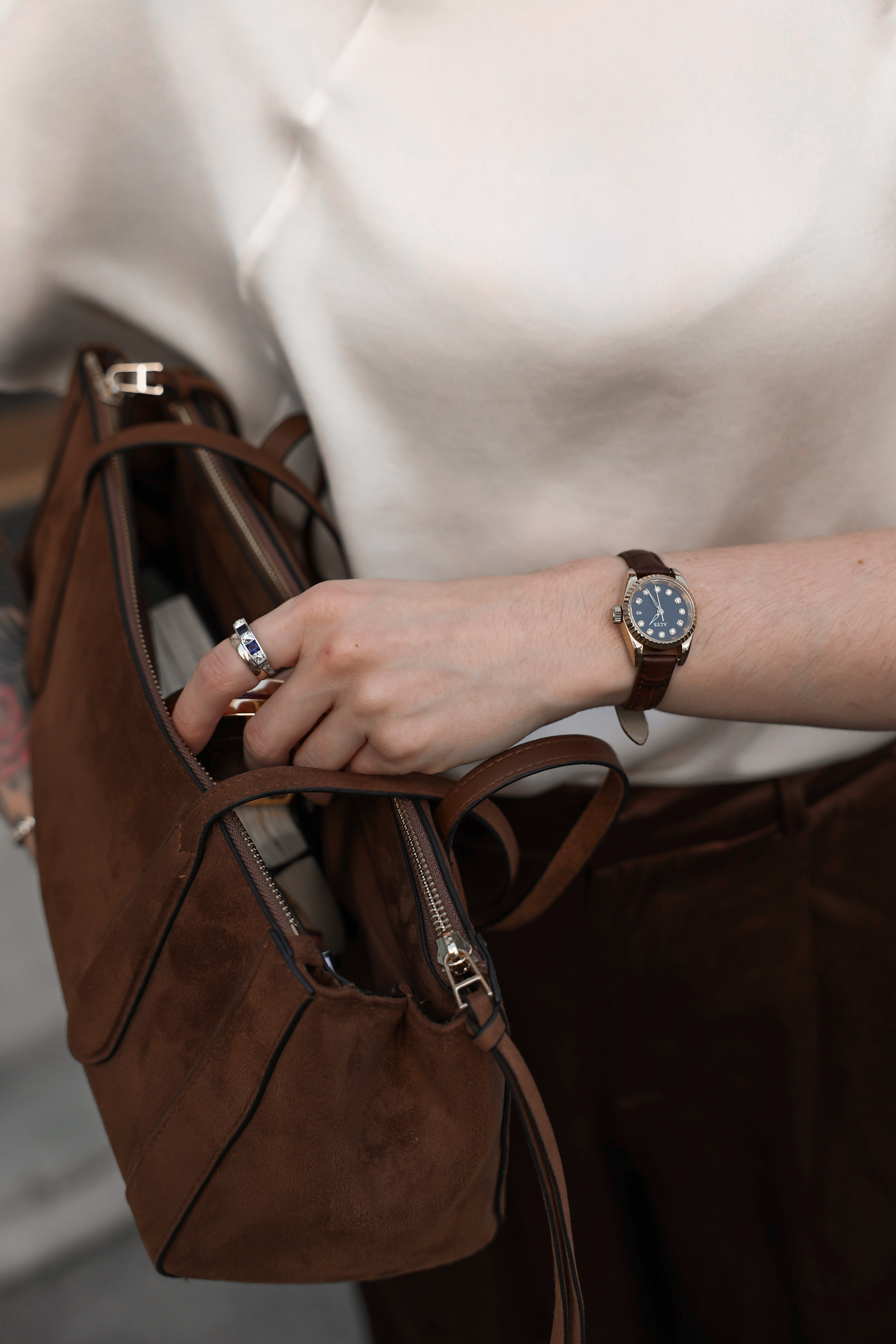
There are watches, and then there are watches that change the way you think about getting dressed.
I have always been much more interested in the second category. A watch, to me, is one of the few pieces of jewelry that can say an extraordinary amount about you without making any effort to do so. It can disappear beneath a cuff or become the first thing someone notices when you walk into a room, and unlike most jewelry, it carries a concept with it that I find particularly interesting: time.
I’ve also become increasingly convinced that women are often given a rather boring selection when it comes to watches. There is a tendency to make women’s watches either impossibly delicate and covered in diamonds or essentially smaller versions of men’s watches. Neither particularly interests me. I want proportion, history, design, exceptional craftsmanship, and personality.
So, if I were putting together my own edit of the watches I would actually consider between roughly €10,000 and €50,000, these are the ten that surely make the list:
1. Cartier Panthère (two-tone or yellow gold) in small

I could hardly begin anywhere else. The Panthère is one of those watches that manages to feel like jewelry without losing its identity as a watch. It was introduced in the 1980s, and its defining feature is that wonderfully supple bracelet, which is what gave the watch its name: the flexibility and movement are meant to evoke Cartier’s panther.
The version I love most is the solid yellow-gold with no diamonds and the classic white dial. There is something incredibly chic about it worn almost like a gold bracelet.
It’s a quartz watch, which makes it even more perfect for a dress watch: its delicate proportions are not distorted by a complicated mechanism. If you’re not into watches, but still want to own something recognizable in the watch world, the Panthère is a great choice.
2. Jaeger-LeCoultre Reverso in pink gold

The Reverso is probably the watch I find hardest to resist intellectually, because there is an actual piece of engineering history behind the design. It was developed in the 1930s after businessman César de Trey was challenged to create a watch that could survive polo matches; the answer was a case that could flip over and protect the crystal. Jaeger-LeCoultre still manufactures the Reverso entirely in-house at its Vallée de Joux manufacture and subjects its watches to the brand’s 1,000 Hour Control testing programme.
For a woman, I particularly love the smaller Reverso proportions. The rectangular case looks incredibly elegant against the wrist, and there is something wonderfully old-world about it. And then there is the back: depending on the model, it can simply be another face of the watch, a different dial, an engraving or something much more personal. That makes the Reverso feel almost like a secret piece of jewelry, a hidden door leading to a forgotten library in an old countryside estate.
3. Omega De Ville Prestige in a small size

Omega is sometimes discussed as though the brand begins and ends with the Speedmaster, which I think does a huge disservice to the De Ville collection. For women, particularly women who prefer smaller round watches, the De Ville is where I would look. The design is restrained, elegant and much less immediately recognizable than some of the louder luxury-watch choices, which I actually consider an advantage. I am particularly drawn to the smallest De Ville models and the classic two-tone + mother of pearl combinations.
There is also something appealing about choosing Omega when you don’t need everyone to know you are wearing Omega. The brand has serious watchmaking credentials, but the De Ville can sit quietly beneath a sleeve and enjoy the underrated quality of such a watch: the ability to be tasteful without looking desperate to prove it.

Chopard is one of those maisons that people often categorise primarily as jewelry, but its watchmaking history is much older and much more serious than that reputation suggests.
Louis-Ulysse Chopard founded a high-precision watch manufacture in Sonvilier, Switzerland, in 1860, specializing in pocket watches and chronometers. The company built a reputation for precision and reliability and supplied watches to organisations including the Swiss railway and even Tsar Nicholas II. The company later moved to Geneva, and under the Scheufele family became the Chopard we recognise today.
The Happy Sport is a very different expression of that history. Introduced in 1993, it became famous for putting freely moving diamonds between two sapphire crystals. Current 30 mm versions of this include automatic movements and are available in precious-metal and diamond-set configurations. And this is the Chopard watch I would choose when I want something more playful. It feels feminine without being twee, proving that sometimes a watch can simply be fun. Personally, I prefer the bracelets to leather straps.
5. A vintage Patek Philippe Calatrava

This is where I would stop thinking about buying a watch and start thinking about buying a magical object. A vintage Patek Philippe is not necessarily going to give you the same striking visual impact as a modern watch (which is in too many cases a great thing (looking at you, Richard Mille)). Some of the most beautiful vintage women’s Pateks are extraordinarily small by today’s standards. Christie’s, for example, has documented a 1957 Patek Philippe ladies’ watch measuring just 16 mm, with a white-gold case, diamond-set bezel and sapphire-set lugs. That is tiny (and completely wonderful).
There is just something about a little vintage Patek on a narrow leather or gold strap that feels almost impossibly sophisticated. It does not look like you bought it yesterday, rather it reflects the lives it has already lived. Browse a quite large selection on Chrono24.
6. Cartier Baignoire in yellow gold

The Baignoire is for the woman who has no interest in timekeeping. Its sensual oval case is one of those designs that looks almost strange when you see it alone and completely right when you see it on a wrist. It has been part of Cartier’s watch vocabulary for decades, and the current collection includes mini, small and medium versions.
I especially love a yellow gold S Baignoire with a black leather strap, but for a more dressed up version my pick is definitely the gold bracelet.

Modern Cartier is wonderful, but vintage Cartier is where romance really lives. A vintage Tank (particularly one in yellow gold, with a slightly aged dial and a simple brown leather strap) has an entirely different presence from a brand-new watch. The proportions are often smaller, the patina is impossible to replicate and the watch can look as though it has belonged to someone interesting for the last fifty years.
I would look particularly closely at vintage Tanks from the mid-century period rather than chasing the newest or most expensive reference. This is also where I would encourage women to stop thinking of watches exclusively as investments. Some watches will hold value better than others; some will hold, some will appreciate and some will not. But the reason to buy a beautiful vintage Cartier is that you want to wear it, not because you have convinced yourself that every purchase is secretly a financial instrument.
8. Rolex Lady Datejust 28 in yellow gold

I know. Putting a Rolex on a list of women’s watches is hardly a controversial decision, but I think the Datejust deserves its place because it is one of those watches that has managed to become both completely recognisable and surprisingly personal. I’m not a Rolex girlie, but even I could be convinced with a 28 mm Lady Datejust, ideally with a champagne, dark brown, or mother-of-pearl dial.
I would actually choose the Datejust over some of the more obviously “feminine” Rolex options because 28 mm is such a good proportion for a daily women’s watch. It has presence without looking oversized, and it retains the slightly sporty, slightly masculine quality that makes a Rolex interesting on a woman. Wear it with a silk shirt, jeans, a cashmere coat, a stack of gold bracelets or absolutely nothing else. It works with all of them.

This is the wildcard, and I think every list needs one. Bulgari’s Serpenti is not pretending to be a traditional watch. The snake has been part of Bulgari’s visual language since the 1940s, and the modern Serpenti Seduttori is the version I would choose for this list. The distinctive snake head-shaped case and flexible bracelet make it feel like a piece of sculptural jewely, rather than a timepiece.
And I actually like the fact that some of the most jewelry-like Serpenti models are quartz. There is an obsession in watch culture with pretending that mechanical automatically means better. It doesn’t always. If what you want is an extraordinary piece of jewelry that happens to tell the time, quartz is perfectly rational. This is also one of the few watches I’m just as likely to buy in steel as I am in gold.

I almost want to put a Breguet here simply because it is the kind of watch people forget to consider when they make lists like this. Everyone remembers Cartier. Everyone remembers Patek. Rolex is inevitable. But Breguet has a completely different kind of history, and the Reine de Naples is one of those rare watches that feels genuinely designed for a woman rather than simply scaled down for one.
The elongated oval case is unusual without being gimmicky, and the collection has a long connection to women’s watchmaking: Breguet traces the design back to a wristwatch created for Caroline Murat, Queen of Naples, in the early nineteenth century. Modern Reine de Naples models combine that recognizable silhouette with mechanical movements, precious metals, diamonds and traditional decorative crafts.
What I love about it is that it doesn’t scream status. It looks like someone with an extremely specific taste chose it, and that is becoming increasingly important to me when it comes to watches. Once you move beyond buying the names, the question becomes much more interesting: what do you actually find beautiful?
Leave a Reply